


TL;DR: Community debt builds up when we choose speed, scale or convenience today and pay for it in member experience later. The ten common types are audience debt, growth debt, architecture debt, content debt, feedback debt, culture debt, trust debt, process debt, decision debt and people debt. Each one adds friction to your community flywheel. You pay it down by mapping your community as a system, tidying up regularly, and testing every new idea against the flywheel before you add it.
What is community debt?
Community debt is the build-up of things that cause unnecessary work, bloat or a worse experience for members. Typically it leads to inefficiencies and structural issues that make the community harder to run. It usually comes from putting community scale ahead of the quality of growth. Like technical debt in software, some of it is a sensible trade-off at the time. It only becomes a problem when nobody pays it back.
Community debt is not always a mistake. Sometimes you take it on knowingly, to get something off the ground. The trouble starts when you forget you borrowed it.
Why community debt matters
Most communities don't stall because of one bad decision. They stall because of hundreds of small ones that nobody went back to. An extra Slack channel here. A big launch that pulled in the wrong crowd. A process that made sense with five volunteers and makes no sense with fifty.
I first wrote about this in Some things you can tidy up in your community, where I described community debt as prioritising activities that will later hurt the community experience. That post was a tidy-up checklist. This one goes further: naming the different kinds of debt, so you can spot which ones are slowing you down.
Community debt starts to become obvious when visibility is lost. It almost becomes a sense of loss of control. There is too much happening and it becomes too overwhelming. It could show up as too many conversations, or too little. It could show up as chaos and too much content. Sometimes it can show up as a new piece of content and not knowing where to put it. Yup, I've been there, and done that.
The 10 types of community debt
There are ten types of community debt worth tracking: audience, growth, architecture, content, feedback, culture, trust, process, decision and people. They overlap, and one usually feeds another.
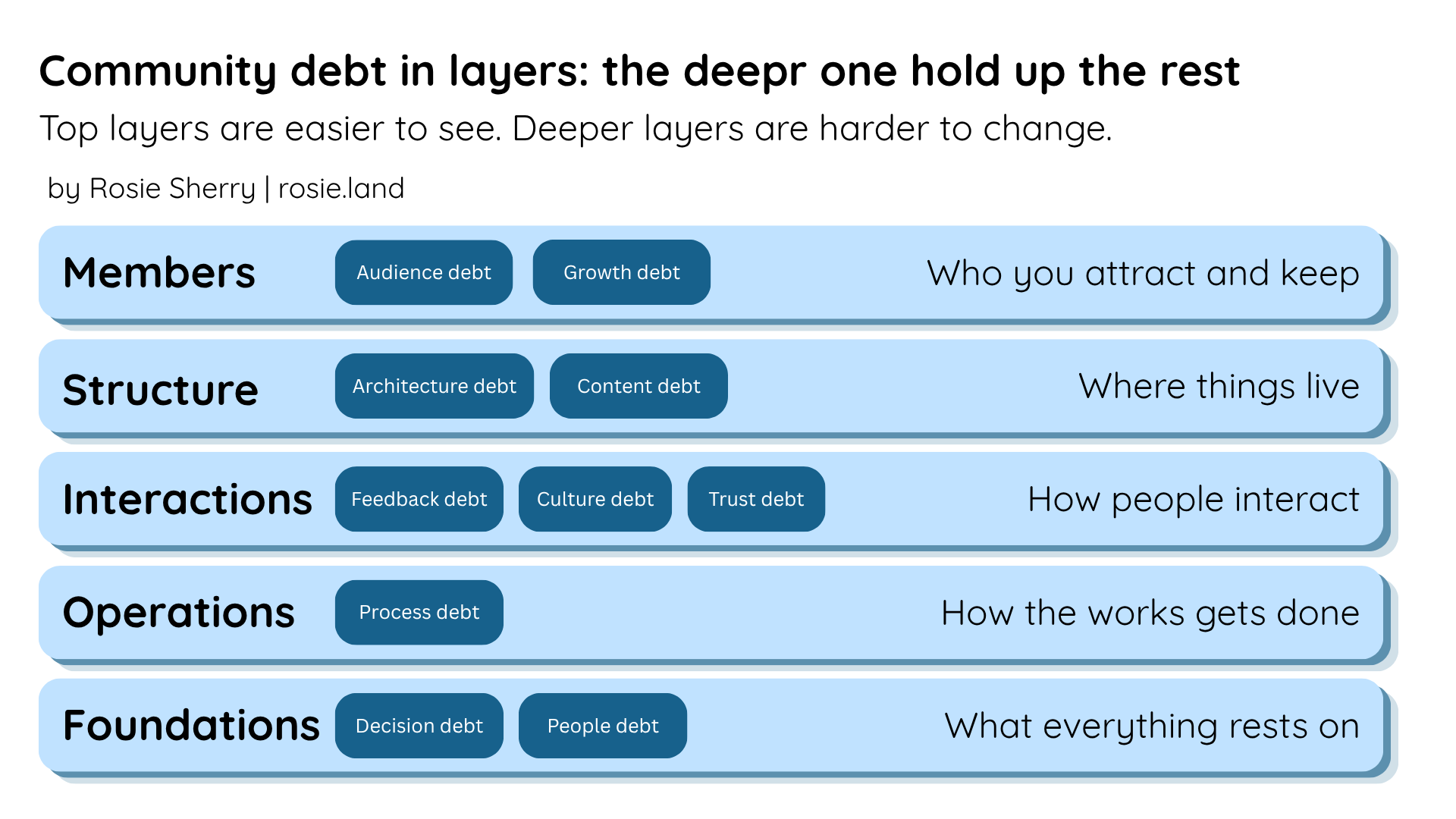
The ten types sit in five layers, from what members notice first down to the foundations that everything else rests on.
Type | What it looks like | Usual cause | First thing to try |
|---|---|---|---|
Audience debt | Big following, few real conversations | Chasing reach before fit without community care | Segment and talk to the people who reply |
Growth debt | Thousands of inactive accounts, messy data | Vanity metrics, no maintenance | Clean out inactive members and old lists |
Architecture debt | Too many spaces, tools and subscriptions; members get lost | Adding without removing, bolting on new platforms | Map your spaces, tools, contracts and what depends on what; simplify in stages |
Content debt | Outdated articles, stale answers and broken links still being found | Publishing without maintaining | Date, update, merge or redirect your most visited content |
Feedback debt | Newcomers feel piled on | Public correction by many people at once | Redesign how feedback is given |
Culture debt | Stated values and real behaviour drift apart | Tolerating poor behaviour; growth outpacing norms | Act early on small things and model what you want |
Trust debt | Members stop replying, volunteering and sharing ideas | Asking for input and never closing the loop | Show members what changed because of them |
Process debt | Workarounds, manual steps, dated tools | Processes built for a smaller community | Write down and retire one process a month |
Decision debt | Old promises and platform choices you can't undo | Decisions never revisited | Review your biggest past decisions yearly |
People debt | Roles, responsibilities and goodwill that no longer fit | Team built for an old shape | Map every role to a flywheel step |
Audience debt
Audience debt is the overhead and loss of focus that comes from building a large, unaligned or disengaged following. It looks great on a dashboard. It feels terrible to run.
When most of the people following you came for a giveaway, a viral post or a single topic you've since moved on from, every interaction takes more sifting. The few people who actually want to take part get buried. Moving people from passive listeners to active members gets harder, not easier, because you are talking to a crowd that never signed up for that.
When an audience isn't quite aligned to where your community is heading, it actually creates more work and the data you work with may end up becoming misleading.
Audience is not community, but audiences are often necessary to help get communtiies going. A large follower count is not evidence of a working community, and treating it as one is how audience debt starts.
Growth debt
Growth debt is the administrative and cultural mess left behind when you prioritise rapid growth or vanity metrics over the member experience. It is the most common form of community debt, and the one people most often mean when they use the term.
It shows up as thousands of accounts that haven't logged in for years, email lists full of dead addresses, member data nobody can explain, and onboarding that assumes a smaller community. It also shows up culturally: norms get diluted when people arrive faster than they can learn how things work.
A typical fix: a moderator deactivates every account that hasn't logged in for over a year. Your numbers drop. It becomes easier to manage. Your community gets healthier.
Architecture debt
Architecture debt is the build-up of spaces, structures, features, tools and running costs that makes a community hard to understand, find your way around or take part in. Navigation is the part members feel first, but the debt usually runs deeper than menus.
Community architecture covers how your spaces are organised, how channels, groups and categories relate to each other, how content is tagged and stored, how member tiers and permissions work, and how your platforms connect. Architecture debt grows quietly, because adding a channel, a category or a new tool is easy, and removing one feels like taking something away. Bolting a new platform onto an old one is a common cause: the same conversation ends up split across Slack, a forum and a website.
Architecture debt also has a price tag. Every space, platform and integration comes with running costs: subscriptions, licences, hosting and the plugins holding it all together. Tools nobody reviews keep billing long after the space they served has gone quiet. Mapping your architecture shows you what you're still paying for and no longer using, even if you can't cancel it straight away.
The result is spread-out conversations, empty rooms, duplicated content, search that doesn't find anything and newcomers who don't know where to start.
Architecture debt is rarely quick to fix. Spaces, tools and integrations depend on each other, so removing one thing often breaks another: a channel that feeds a newsletter, a forum category that old links point to, an automation that only works with one platform. You may also be locked into contracts, annual subscriptions or data that is hard to export.
Start by mapping your structure as it really is, including what depends on what and what you're committed to. Then simplify in stages: archive the obviously dead spaces first, and plan bigger moves, like merging platforms, around renewal dates and migrations. I've listed more places to look, from events to email lists to onboarding, in Some things you can tidy up in your community.
Content debt
Content debt is the build-up of outdated, duplicated or inaccurate content that people still find and trust: old articles, stale answers, abandoned threads and broken links.
Every community produces content, and most of it is never revisited. A how-to written five years ago still ranks. An answer that was right before a tool changed still gets linked. Search engines and AI tools now surface old answers as if they were current, so content debt reaches people who have never visited your community.
Like architecture debt, you can't simply delete it. Old pages carry links, rankings and history. Start with your most visited content, add clear dates, then update, merge, redirect or archive it. Give your important pages an owner so someone looks at them again.
Feedback debt
Feedback debt is the build-up of negative emotional impact on members when several people publicly correct or critique the same action at once, however polite each person is being.
A great write-up I know of comes from Sara Chipps at Stack Overflow. After a Friday afternoon of colleagues pushing back on a new policy, she went back through the Slack history expecting to find rude messages and found reasoned arguments instead. Her conclusion was that the harm came from the volume of people disagreeing in public at the same time, not from any one person. She then linked that to Stack Overflow's question-closing process, where many users pointing out a newcomer's mistakes felt hostile even when no single comment was.
That is feedback debt: a system working as designed, and still pushing people away. Each small correction is reasonable. The total cost is a newcomer who never posts again.
Culture debt
Culture debt is the gap that builds up between the values a community says it holds and how people actually behave in it.
It often starts with one exception. A star member who contributes a lot gets away with being dismissive. A heated thread is left alone because stepping in feels awkward. Rapid growth brings people in faster than they can learn how things work, and the norms get thinner each time. Nobody decides to change the culture. It drifts.
Culture debt is one of the most damaging types and one of the hardest to reverse, because members learn from what is tolerated, not from what is written down. As I wrote in Let's build some community flywheels, guidelines don't make a great culture; actions do. Act early on small things, and build habits that show the behaviour you want, as I describe in Community culture flywheels.
Trust debt
Trust debt is the build-up of small broken promises between a community and its members: input asked for and never acted on, commitments that aren't actioned, and messages left unanswered.
Each instance is minor. A survey with no follow-up. A roadmap item that never ships. A "we'll look into it" that nobody looks into. Over time, members learn that taking part changes nothing, and they stop replying, volunteering and sharing ideas. Community debt can be framed largely in these terms, as underinvestment in relationships and trust, and suggests showing members that their input leads to change.
Trust debt overlaps with decision debt, but it is about the relationship rather than the decision. The fix is to close the loop: tell people what changed because of them, make fewer promises, and keep the ones you make.
Process debt
Process debt is the stack of manual steps, workarounds and dated tools that made sense when the community was smaller and now slow everyone down.
It looks like the onboarding spreadsheet only one person understands, approvals that need three people, or automations nobody dares switch off. Stack Overflow is a good example here too: in the same post, Chipps describes moderator tools that had barely changed since launch, and calls updating them paying down debt. Process debt lands hardest on your most committed people, because they are the ones doing the workarounds.
Often community managers don't realise how overcomplicated tasks are until they are able to improve them. It is the efficiencies that they subsequently discover that helps them measure the real ROI of investing in process improvements.
Decision debt
Decision debt is the weight of past choices that still shape what you can do today, long after the reasons behind them have changed.
It includes the platform you picked years ago, a free-forever promise, a pricing structure, a membership tier, a naming choice, or a format adopted in a hurry. Moving everything online during the pandemic is a good example: sensible at the time, and for many communities still not fully revisited. Decision debt is hard to see because it feels like "just how things are".
This is why I advocate for a research and a Minimum Viable Community (MVC) type approach to community. When we spend time researching, we naturally end up making better decisions. Also when we build with and MVC mindset, we are experimental and open minded to what the best outcome should be.
People debt
People debt is the build-up of roles, responsibilities and expectations that were set up for an earlier version of your community and no longer fit.
It can be a team structure designed around a product you've moved away from, a job description nobody has updated in years, or a volunteer who has quietly become the only person holding something together. It is the most uncomfortable type to talk about because it involves people's jobs, valuable contributions and goodwill. It is also one of the most expensive to ignore, because every month it carries on, it costs real energy and wears out the people you most need.
How community debt slows your community flywheel
Community debt acts as friction on your community flywheel. Every type of debt slows one or more steps in the loop, and a slower loop means less momentum for everything else.
A community flywheel is a model for community building where each activity feeds the next, so effort compounds instead of starting from zero each time. I've written about this before in Let's build some community flywheels and Community culture flywheels. A simple example loop:
- Someone discovers the community through useful content or a recommendation.
- They join and find their way to the right place.
- They make a first contribution: a question, a reply, a story.
- That contribution gets a good response and is shared or featured.
- The shared contribution brings in the next person.
Now layer the debt on top. Audience debt weakens step 1, because you attract people who were never going to stay. Architecture debt and growth debt slow step 2, and they come back at step 5: people hold back from inviting others into a space that's cluttered, hard to find your way around or full of inactive accounts. Feedback debt stops step 3 cold. Process debt drags on step 4, because featuring good work takes too many manual steps. Decision debt and people debt sit underneath the whole wheel, deciding how fast it can turn at all.
The other types fit the same picture. Content debt also weakens step 1, because people discover you through answers that are out of date. Culture debt and trust debt sit beside feedback debt at step 3: why contribute if poor behaviour goes unchecked, or if your input disappears?
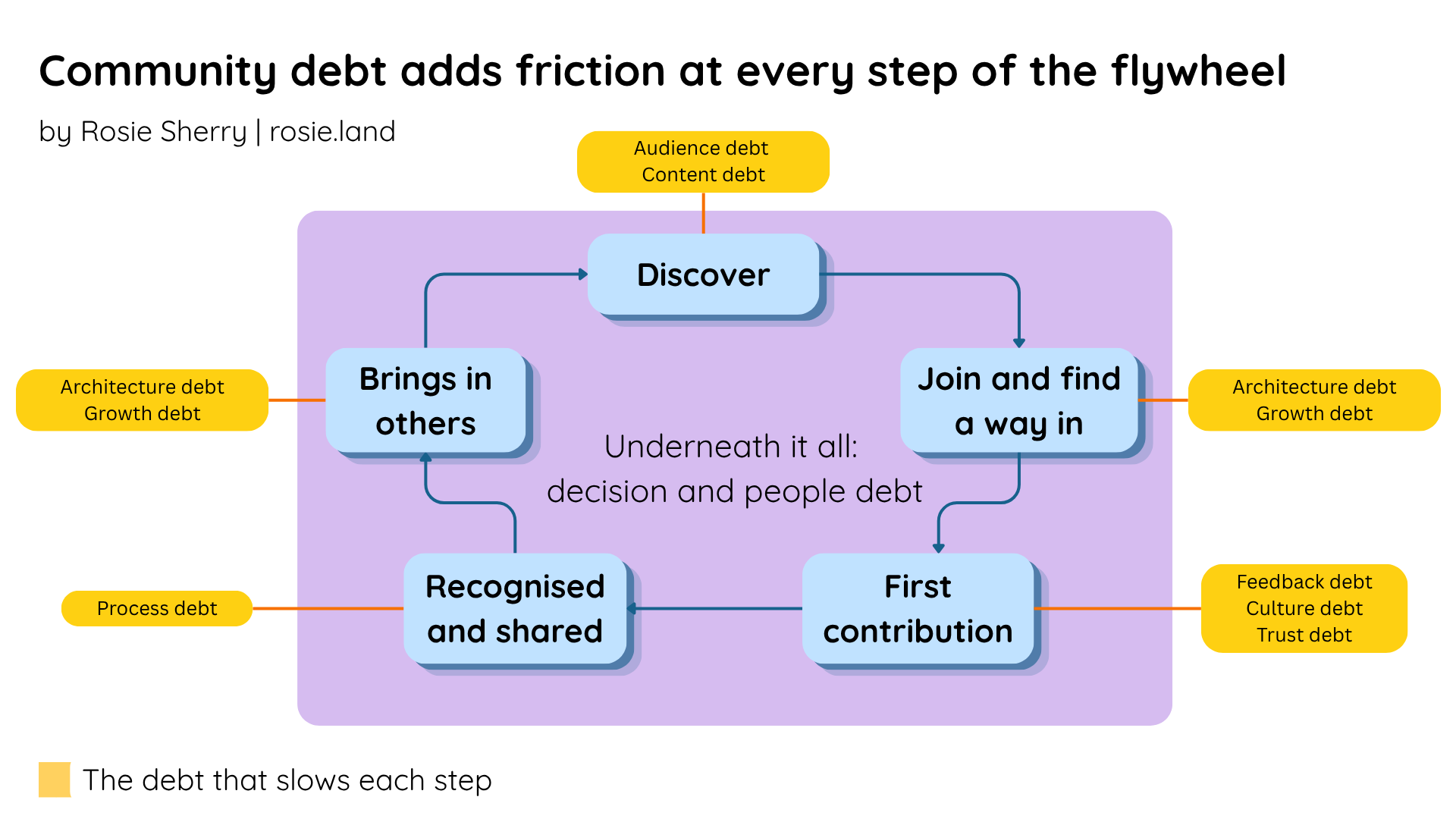
Each shaded tag shows which debt slows that step; decision debt and people debt sit under the whole wheel.
This is why debt is so hard to spot from metrics alone. You rarely see one big failure. You see a wheel that needs more and more pushing to keep the same speed.
8 tips to pay down community debt
The most reliable way to pay down community debt is to stop treating it as a one-off clean-up and start treating your community as a system. Flywheels show you where the friction is. Systems thinking shows you why it keeps coming back. The Ahh Test helps you stop adding more.
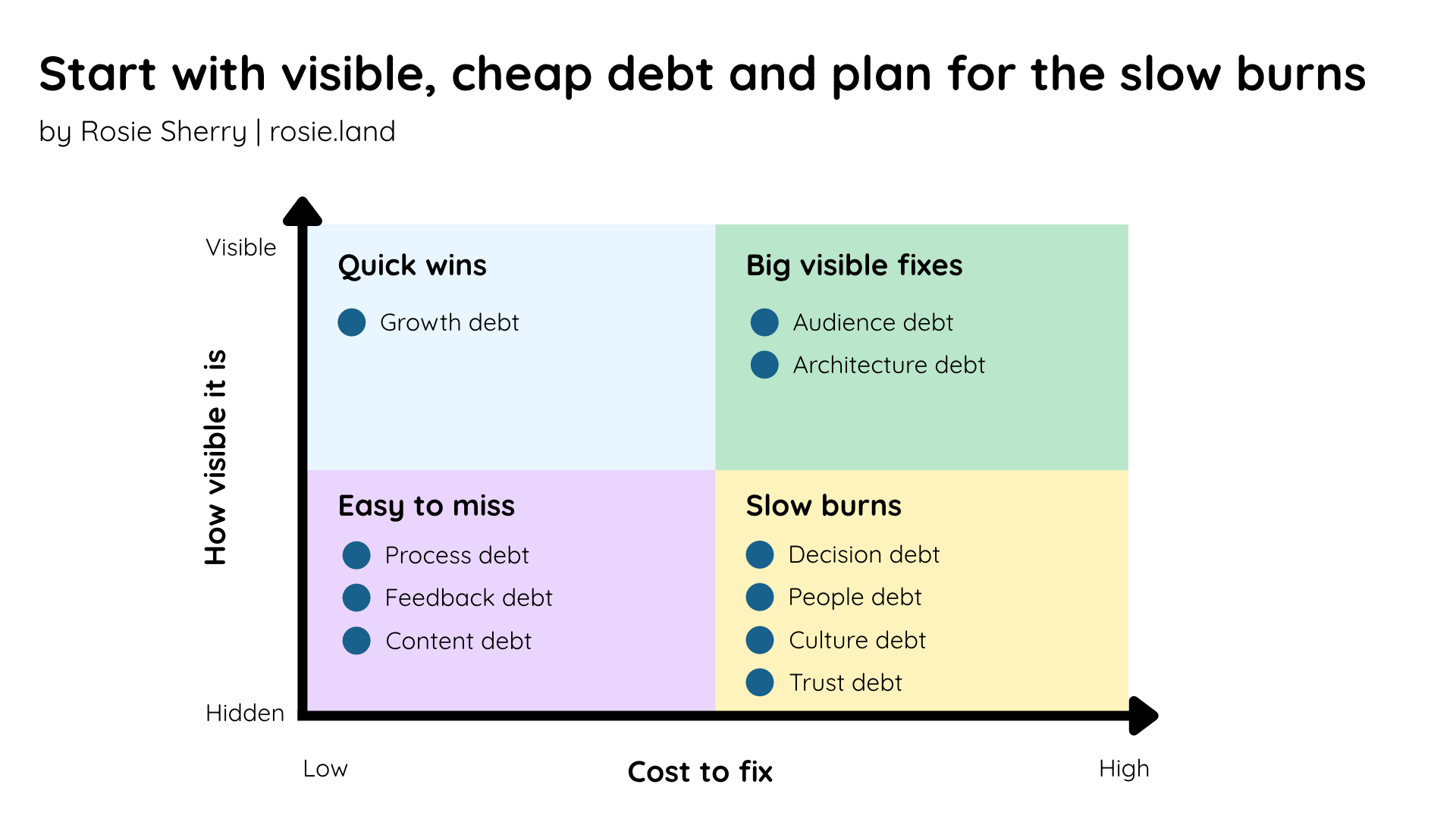
Growth debt is usually the quickest win. Architecture debt is easy to see but slow to fix, because spaces, tools and contracts are tangled together. Content debt is easy to miss, because you rarely reread your own archive. Decision, people, culture and trust debt need the longest plan. Treat the placements as a starting point and move them to fit your own community.
1. Draw your flywheel before you fix anything
Sketch the loop your community actually runs on, not the one in your strategy deck. Then mark where things slow down. Debt is easiest to prioritise when you can see which step it is choking.
2. Think in systems, not tasks
Community debt is rarely a single problem. It is an accumulation of many things. Ask what is producing the debt, not just how to clear it. If inactive channels keep piling up, the fix is a rule about when channels get created and archived, not a one-off purge. I've explored this in Thinking in community systems.
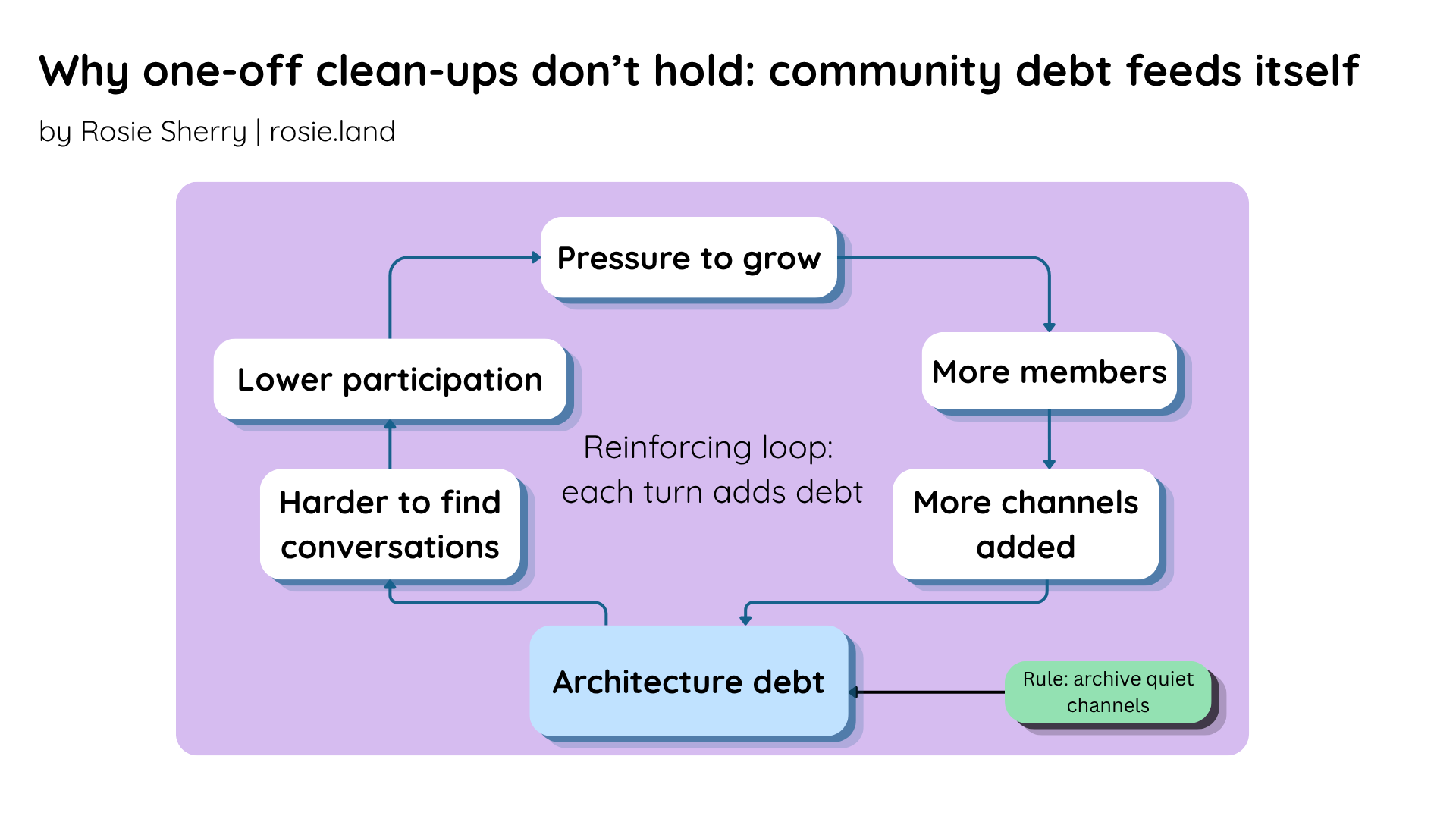
A purge clears the debt once; a standing rule sits inside the loop and keeps weakening it every time it turns.
3. Run every new idea through The Ahh Test
The Ahh Test is a model we use at Ministry of Testing to check whether a decision moves us towards our goals. Before adding a channel, an event series, a tool or a role, ask: does this pass The Ahh Test? Does it help the flywheel turn, or is it future debt?
It is deliberately simple. As I wrote in Simplicity is at the core of The Ahh Test, it touches on culture, flywheels, needs, purpose, progress, complexity, data, feelings and decisions. That makes it a good fit for catching debt before it starts. The full series is in The Ahh Test collection on the MoTaverse.
4. Schedule regular tidy-ups
Put a recurring tidy-up in the calendar: quarterly works for most communities. Use the checklist in Some things you can tidy up in your community to cover members, events, email lists, conversations, content, channels, processes, automation, values, onboarding and leaving.
5. Measure health, not size
Growth debt and audience debt both come from rewarding the wrong numbers. Track active contributors, replies to first posts and repeat attendance instead of total members. I've argued for this in Don't obsess over community engagement.
6. Redesign how feedback reaches newcomers
If feedback debt is building, change the system, not the people. Route corrections through one person, use private nudges before public ones, and recognise good first contributions before pointing out what's wrong.
7. Revisit your big decisions on purpose
Once a year, list the five decisions that shape your community most: platform, pricing, membership model, team structure, main formats. For each, ask whether you would make the same choice today. If not, plan the exit, even if it takes a year.
8. Start small when you add anything new
The cheapest debt is the debt you never take on. Use a Minimum Viable Community mindset: test the smallest version of a new space, event or programme before committing people, money and members' attention to it.
Where to start
Pick one type of community debt, the one you feel most this week, and trace it back to the step of your flywheel it is slowing. Fix the system that creates it, not just the symptom. Then run your next new idea through The Ahh Test before it becomes next year's debt.
Which type of community debt is holding your community back right now? I'd love to hear in the comments, or come and talk about it in the Rosieland Slack.
Community debt FAQs
What is community debt?
Community debt is the build-up of shortcuts and past choices that create extra work or a worse member experience later. It usually comes from prioritising scale or speed over the quality of growth.
Is community debt the same as technical debt?
No, but it works the same way. Technical debt lives in code. Community debt lives in your members, spaces, tools, processes, decisions and people. Both compound if you ignore them.
What is audience debt?
Audience debt is the overhead and loss of focus caused by a large, unaligned or disengaged following. It makes it harder to find the people who want to take part and harder to turn listeners into active members.
What is feedback debt?
Feedback debt is the negative emotional impact on a member when several people publicly correct the same action at once. Each comment can be polite and the total effect can still drive people away.
What is architecture debt?
Architecture debt is a community structure that has grown too complex: too many spaces, categories, tools and features for members to find their way or know where to take part. Navigation problems are the most visible sign. It is rarely quick to fix: map the structure, work out what depends on what, and simplify in stages.
What is growth debt?
Growth debt is the administrative and cultural mess left behind when a community prioritises rapid growth or vanity metrics over the member experience, such as inactive accounts, dead email lists and messy member data.
What is content debt?
Content debt is the build-up of outdated, duplicated or inaccurate content that people still find and trust, such as old articles, stale answers, abandoned threads and broken links.
What is culture debt?
Culture debt is the gap that builds up between the values a community says it holds and how people actually behave in it. It often starts with tolerating poor behaviour from a valued member.
What is trust debt?
Trust debt is the build-up of small broken promises between a community and its members, such as input asked for and never acted on, commitments that drift and messages left unanswered.
What is process debt?
Process debt is the stack of manual steps, workarounds and dated tools that made sense when a community was smaller and now slow everyone down.
What is decision debt?
Decision debt is the weight of past choices, such as platforms, pricing or promises, that still shape what a community can do long after the reasons behind them have changed.
What is people debt?
People debt is the build-up of roles, responsibilities and expectations set up for an earlier version of a community that no longer fit.
Is all community debt bad?
No. Taking on some debt to launch or test an idea is often the right call. It becomes a problem when nobody tracks it or pays it back.
How do I reduce community debt?
Map your community flywheel, find where it slows down, and fix the system creating the friction. Schedule regular tidy-ups and test new ideas with something like The Ahh Test before adding them.

